EMT Practice Test

1. Question Content...


Question List

Question1: Which of the following one is the method of reducing system nervousness?

Question2: A company ships a particular product to a market located 1000 miles from the plant at a cost of $4 per mile. Normally it ships 500 units at a time. If the company can ship the units unassembled, it can ship 800 units in a truck. What is the line-haul cost per unit now?

Question3: A manufacturer has the alternative of making parts in-house or of buying them from an outside supplier. Reason/s to buy out may be:

Question4: A price that is competitive, gives the seller a profit, and allows the buyer ultimately to sell at a profit is known as:

Question5: The major effect that just-in-time has on forecasting it's shortened,

Question6: The process of determining in detail the amount of labor and machine resources needed to achieve the required production id known as:

Question7: What is calculated by taking into account the work center utilization and efficiency?

Question8: A work center is available 120 hours but actually produced goods for 100 hours. What is the utilization of the work center?

Question9: What record in sequence only the main operation and inspection and are useful; for preliminary investigation and give a bird's-eye view of the process?

Question10: A process costs $200 to set up. The run time is 5 minutes per piece and the run cost is $30 per hour. Determine the fixed cost?

Question11: Transportation
Distribution inventory
Warehousing
Packaging
Material handling
Order Entry
These are the activities of:

Question12: Capacity needs to be measured on following levels EXCEPT:

Question13: Which one of the following is Not out of five basic inputs to the manufacturing planning and control system?

Question14: Toyota has designed seven important sources of waste in manufacturing. The first four relate to the design of the manufacturing system and the last there to the operation and management of the system. Which one of the following is NOT out of those sources of waste?

Question15: The Economic-order quantity will increase as the annual demand and the cost of ordering decrease, and it will decrease as the cost of carrying inventory and the unit cost increase.

Question16: The needs of the customer are gathered using various survey methods or by comparing a company's own products against the competitions, these wants are referred to as:

Question17: Which of the following best describes JIT?

Question18: Extranet is an internet shared by two or more companies.

Question19: Operation number
Setup hours, planned and actual
Quantity reported complete at the operation
Quantity reported scrapped at that operation
Due date or lead time remaining
These are the components of related to each operation.

Question20: The capacity requirements plan occurs at the level of:

Question21: Which of the following are the two sources of specifications?

Question22: Which of the following is generally a function of the physical distribution system?

Question23: Projected available balance is calculated in which one of the following ways?

Question24: Which of the following is an advantage of VMI?

Question25: Who is responsible for meeting the minimum specifications of the product design?

Question26: and products made. depends on the design of the product and the mix of the

Question27: Buyers in which environment need suppliers who value their new relationship, working in partnership to remove waste from the system?

Question28: A simple system that signals the need for more products is known as:

Question29: What implies understanding and correctly implementing the major enterprise-wide changes required to truly eliminate or significantly reduce waste in the system?

Question30: A company normally ships to a customer by rail at a cost of $500 per load. The transit time is fourteen days. The goods can be shipped by truck for $700 per load and transit time of four day. If transit inventory cost is $35 per day, what does it cost to ship each way?

Question31: Price competition is often severe and profits start to decline, in which phase of the life cycle of a product?

Question32: A routing file should contain the following information EXCEPT:

Question33: As 1980 gave way to the 1990 the world continued to change, forcing additional changes in supply-chain concepts. All of the following statements depict those changes EXCEPT:

Question34: A company wants to produce 500 units over the next 3 months at a level rate. The months have 19, 20 and 21 working days, respectively. On the average, how much should the company produce each day to level productions?

Question35: The costs of correcting problems after goods or services have been delivered to the customer are called internal failure costs.

Question36: When a calculation is made to find out how many are needed, the quantities available must be considered in:

Question37: The orders are automatically scheduled and controlled by the computer are the orders called:

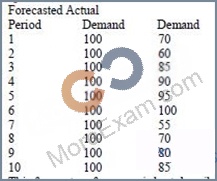
Question38: Forecasted Actual

This forecast performance is best described as:

Question39: The step for preparing MPS is/are:

Question40: As applied to inventories, it is usually found that the relationship between the percentage of items and the percentage of annual dollar usage follows a pattern in which three groups can be defined:
Group A About 50 % of the items account for about 5 % of the dollar usage Group B About 20 % of the items account for about 80 % of the dollar usage Group C About 30 % of the items account for about 15 % of the dollar usage

Question41: Today production control works in a demanding environment shaped by six major challenges. Which one of the following is not of those challenges?

Question42: A work center has 3 machines and is operated for 8 hours a day and 5 days a week. What is the available time?

Question43: Which of the following is NOT the manufacturing lead time?

Question44: The formula to calculate the Inventory turns is:

Question45: Which technique is based on the assumption that what happened in the past will happen in the future?

Question46: Which forecast performance measure detects bias?

Question47: When a small number of items often dominate the results achieved in any situation, this is called:

Question48: What includes the functions of establishing specifications, selecting suppliers, price determination, and negotiation?

Question49: To maintain the desired level of customer service by maintaining finished-goods inventory levels or by scheduling to meet customer delivery requirements.
1. To make the best use of material, labor and equipment.
2. To maintain inventory investment at the required levels.
These are the objectives of:

Question50: Which of the following is NOT categorized modeling approaches in SCM?

Question51: ABC Company has decided to implement point of use replenishment with a key supplier. Which action is consistent with this decision?

Question52: Which of the following is an artificial grouping of components for planning purposes?

Question53: When a supplier maintains an inventory of certain items in the customer's facility, this approach is known as:

Question54: What consists of taking a sample of a batch of product and using it to estimate the overall quality of the batch?

Question55: Engineering drawings and specifications and bill of material are the methods of:

Question56: Which function is to determine the need for labor, equipment, and material to meet the priority plans?

Question57: Life cycle approach for identifying order winners and qualifiers is complicated in that:

Question58: Total the forecast demand for the planning horizon.
Determine the opening inventory and the desired ending inventory
Calculate the total production required as follows:
Total Production = total forecast + back orders
+ ending inventory - opening inventory
Calculate the production required each period by dividing the total production by the number of periods.
Calculate the ending inventory for each period.
Above is the general procedure

Question59: A calculated extra amount of stock carried and is generally used to protect against quantity uncertainty in known as:

Question60: Physical distribution contributes to:

Question61: This figure shows that:
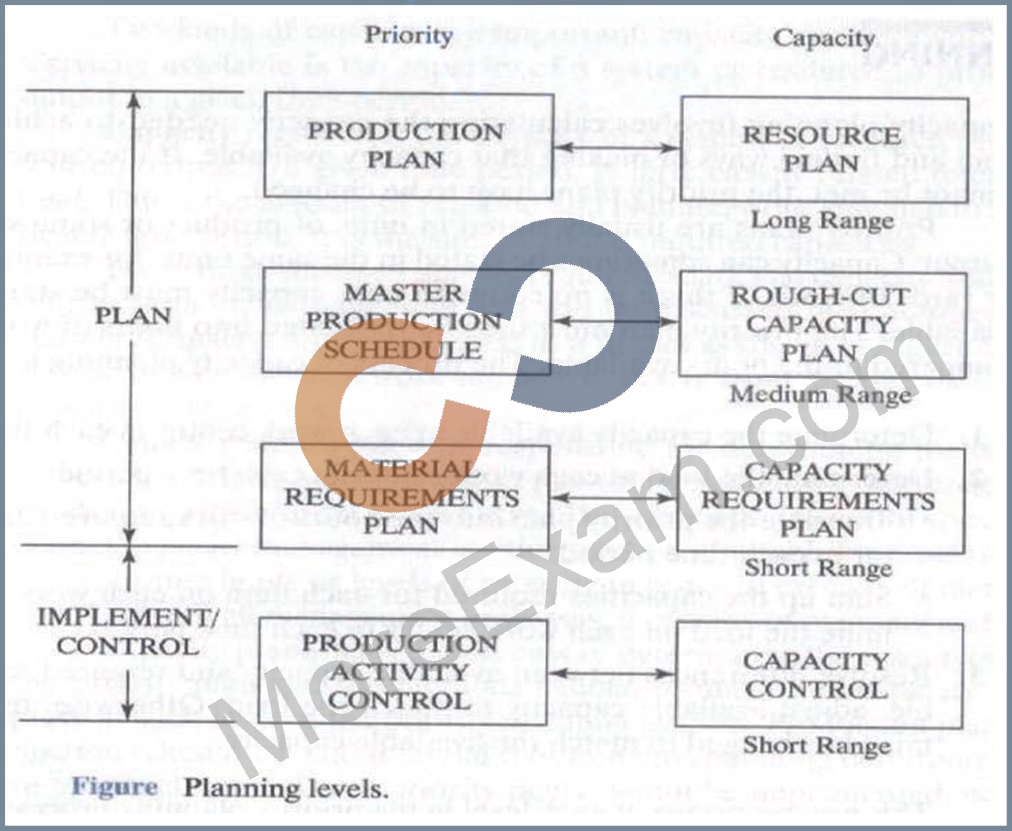
Question62: A systematic method by which organizations can compare their performance in a particular process to that of a "best in class" organization, finding out how that organization achieves those performance levels and applying them to their own organization, is called:

Question63: What can affect the trend, seasonality, or randomness of the actual demand?

Question64: Goods are not made continuously as in a flow system but are made at intervals in lots or batches in:

Question65: Each of the following actions would reduce safety stock levels EXCEPT:

Question66: The level of detail in strategic business plan is:

Question67: The planning horizon is usually and is reviewed perhaps .

Question68: Stock, from which withdrawals are made, can be located close to the marshalling and shipping area is referred to as:

Question69: The specific way in which materials move depends upon which of the following factor?

Question70: For each product
how the product is made.

Question71: Over a 4-week period a work center produced 540 standard hours of work was available for 640 hours, and actually worked 480 hours. Calculate the utilization and the efficiency of the work center.

Question72: Assemble- to-order is a subset of make-to-order. Which of the following is needed to make a production plan for make-to-order products?

Question73: Preventive maintenance plus continuing efforts to adapt, modify, and refine equipment to increase flexibility, reduce material handling, and promote continuous flow, is called:

Question74: In terms of structure and function, the construction supply chain is characterized by the following element/s:

Question75: Goods or services satisfy the needs and expectations of the user, this refers to:

Question76: A tool to map and understand the flow of materials from supplier to customer, focusing on not only understanding the current state of process and flow but also specifying the value-added and non-value-added time of all process steps, is called.

Question77: Annual cost of pacing orders and annual cost of carrying inventory, together forms:

Question78: The plan must be checked against available capacity when needed to make the components is called the process of

Question79: is the sum of queue, setup, run, wait and move times at work center.

Question80: A planned order receipt is generated by MRP when:

Question81: A difference between the physical count and inventory dollars for the inventory records is called:

Question82: Multilevel bills are formed as:

Question83: The usual process is to start with the due date and, using the lead times, to work back to find the start date for each operation, this process is known as:

Question84: is the most detailed, complete and accurate of the capacity planning techniques.

Question85: Using non-cumulative methods, what is the ATP in period 1?
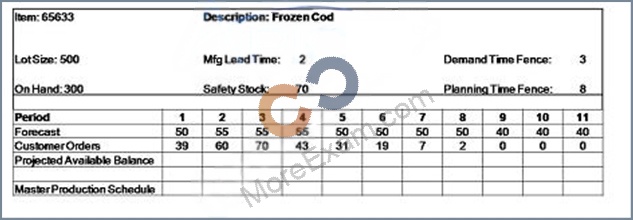
Question86: The consolidation of several units into large units, called unit loads, so there is less handling, this is referred to as:

Question87: All of the following are ways to achieve financial objectives EXCEPT:

Question88: Government regulations majorly apply to areas as:

Question89: The capacity planning process occurs at each level in the priority planning process, varying only in:

Question90: What is the updated forecast, utilizing exponential smoothing, given the following data?
Old Forecast = 100, actual demand = 80, alpha = 0.2, tracking signal = 0.9

Question91: Order winning characteristics are defined primarily from:

Question92: Which of the following is NOT the dimension to quality measurements?

Question93: Repetitive Manufacturing and continuous manufacturing are types of:

Question94: What occurs when the cost of ordering equals the cost of carrying?

Question95: Planning horizon means

Question96: The CPI system is based on the scientific methods. This general method is used to solve many kinds of problems. Which of the following is NOT the out of six steps continuous improvement process?

Question97: To design products for low-cost manufacture requires close coordination between product design and process design, which is called:

Question98: What is responsible for executing the master production schedule and the material requirements plan?

Question99: What is needed for items and is associated with master production scheduling?

Question100: There are following reasons of using sample inspections:

Question101: Over a period of 4 weeks, a work center produced 50, 45, 40, and standard house of work. What is the demonstrated capacity of the work center?

Question102: To satisfy the financial auditors that the inventory records represent the value of the inventory, this is the purpose of:

Question103: An open order appears as a/an on the MRP.

Question104: Capacity planning links the various production priority schedules to :

Question105: Product design engineers sometimes change the design of a product and the components used. These changes must be recorded and controlled. The bill provides the method for doing so is called

Question106: Which of the following is the activity of Demand management?

Question107: How many types of demand are in Material Requirements planning?

Question108: Companies that produce a narrow range of high-volume products will most likely choose which of the following processes?

Question109: The process capability index combines:

Question110: To result in optimal performance for customer service and cost, it is felt that the supply chain of activities as an extension of partnership. This implies many issues, but critical one/s include/includes:

Question111: A statistical value that measures how closely the individual values cluster about the average is called:

Question112: Find methods to maximize the utilization of the constraint toward productive throughput is called:

Question113: Using the , the quantity on hand of a particular item is determined at specified, fixed-time intervals and an order is placed.

Question114: and uncouples the sales forecast from manufacturing by establishing a manufacturing plan

Question115: Manufacturing processes can be conveniently organized into which of the following three categories?

Question116: In some industries, is the only strategy that can be followed. Farmers, for instance, must produce in the growing season. The post office must process mail over the Christmas rush and in slack seasons. Restaurants have to serve meals when the customers want them. These industries cannot stockpile or inventory their products or services and must be capable of meeting demands as it occurs.

Question117: A planned decision by the organization to select one supplier for an item when several sources are available is called:

Question118: On the average a firm has 10 weeks of work-in-process and annual cost of goods sold is $15 million. Assuming that, the company works 50 weeks a year. What is the dollar value of the work-in-process?

Question119: Shifts in the age of the population needs of ethnic groups, low population growth, freer trade between countries and increased global competition all contributes to:

Question120: A facility, function, department, or resource whose capacity is equal to or less than the demand placed upon it is known as:

Question121: The cost of avoiding trouble by doing the job right in the first place is known as:

Question122: Basic strategies that can be used in a production plan may be:

Question123: Which four primary plant types are defined, and they are used to specify the flow of materials through a production process?

Question124: Inventory investment can be balanced with:

Question125: If the cost of manufacturing (direct material and direct labor) is 60% of sales and profit is 10% of sales ,what would be the improvement in profit if, through better planning and control, the cost of manufacturing was reduced from 60%of sales to 50%of sales?

Question126: Which combination of business processes is accurate?

Question127: Following is an example of:
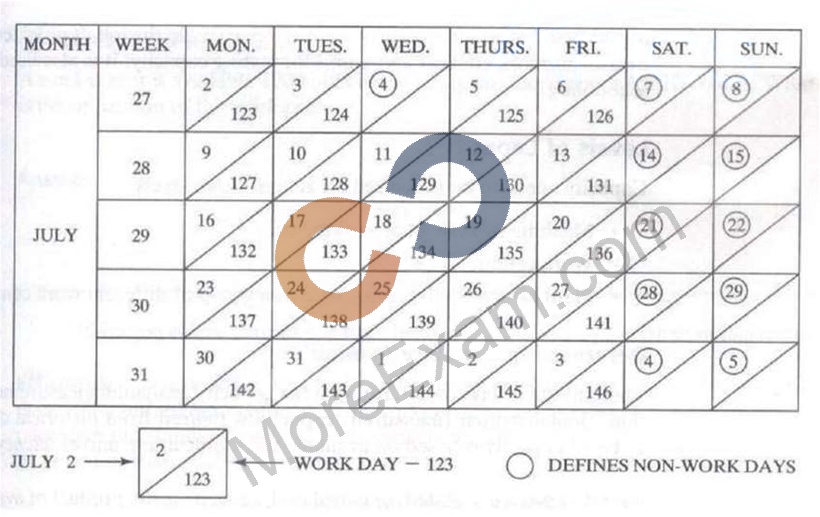
Question128: There are two ways to determining the capacity available; out of which is figured from historical data and is based on available time, utilization and efficiency.

Question129: The tracking signal can be calculated as:

Question130: A work center is to process 150 units of gear shaft SG 123 on work order 333.the setup time is 1.5 hours, and the run time is 0.2 hours per piece. What is the standard time needed or run the order?

Question131: The information needed to develop an MPS is provided by:

Question132: Control is exercised through individual items in a particular inventory, this is called:

Question133: The safety stock required depends on which of the following:

Question134: Important way to resolve conflicting objective is:

Question135: Which one of the following affects capacity available?

Question136: Scheduled receipts shows:

Question137: The needs of sales and the economics of production must be balanced, and this balance is usually obtained with:

Question138: In order to develop possible solutions, which approach to take to help develop a better method?

Question139: Sales 100 100 100 100 100 100
Production 200 200 200 100 100 100
Starting Inventory = 100
The production plan shown above is an example of which production strategy?

Question140: On the overage a company has 12week of work-in-process (WIP) inventory and annual cost of goods sold of 36$ million. Assuming the company works 50 weeks per year. If the WIP could be reduced to 5week, and the annual cost of inventory value what would be annual savings?

Question141: Operations management works in a complex environment affected by many factors. Among the most important are:

Question142: Production activity control in intermittent manufacturing is complex Because of:

Question143: Each distribution center first determines what it needs and when, and then places orders in central supply, in:

Question144: The line between two or more supply sources where the laid-down cost is the same is known as:

Question145: Owner's equity is:

Question146: What represents the master schedule for the operation, which is focused around the pace of throughput as defined by the constraint?

Question147: The available time depends on the number of machines, number of workers and:

Question148: An index of the relative priority of an order to other orders at a work center is referred to as:

Question149: Which of the following strategies is most likely to produce the shortest delivery leadtime?

Question150: is a usual process to start with the due date and using find lead time, to work back to operations?

Question151: If the opening inventory is 400 units, demand is 900 units, and production is 800 units, what will be the ending inventory?

Question152: The demand pattern varies from period o period, and which of the following is the reason for this:

Question153: Raw materials are recorded into work-in-process, when work is completed and becomes finished goods; the work-in-process inventory is relieved by multiplying the number of units completed by the number of parts in the bill of material, in which system?

Question154: Analyzing capital investments by estimating future cash flows and translating them into equivalent amounts in today's terms is called:

Question155: If the beginning projected available balance is 100 units, the forecast is 40 units, and customer orders are 50 units, the ending projected available balance is:

Question156: is an internal net that is normally used within the boundaries of a company.

Question157: is the number of periods 1, in which changes are not expected due to excessive cost caused by schedule disruption.

Question158: At the MRP planning level, the process of priority plans must be checked against available capacity is called

Question159: Much evidence is available that this ideal information system integration is not evolving within industry supply chains, since:

Question160: ERP systems:

Question161: Which of the following is used to convert the master production schedule into detail requirements?

Question162: Exploding is the process of multiplying the requirements by:

Question163: Which of the following plant is used in the production process, where few raw materials can be made into several end products?

Question164: To detect the presence of assignable causes of variation is the objective of:

Question165: What is the rule for forecasting with seasonality?

Question166: The amount of released and planned work assigned to a facility for a particular time period is called:

Question167: Take as an example the supply chain of organizations that represent the flow from raw silicon used to make computer chips to the delivery and disposal of the computer itself:

What is illustrated here is but one chain of a set of different component chains that represent a network of suppliers and distributors for a product to manage a supply chain one must:

Question168: When in a given period, actual demand will vary about the average demand, this is called:

Question169: What exist because of the time needed to move goods from one location to another such as from a plant to a distribution center or a customer?

Question170: _______________ provides a picture, in the form of a diagram, of what actually happens when a product is made or a service performed.

Question171: Every operation producing a product or service is a series of linked processes and each process has a specific capacity to produce the given defined output for the operation, this is called:

Question172: Metrics:

Question173: A routing file should exist for every component manufactured and contain which of the following information?

Question174: Production activity control activities in manufacturing planning and control may also be called:

Question175: The capacity required depends on the particular mix of products being built and is difficult to predict is a characteristic of:

Question176: What serves as a means of identifying the product in a way not possible from its outward appearance?

Question177: Basic concepts in TQM:

Question178: _ is the delivered cost of a product to a particular geographic point.

Question179: Which one of the following should be the result of capacity requirements planning?

Question180: A system that forecasts when the various demands will be made by the system on central supply is known as:

Question181: Each active manufacturing order has a record in which file?

Question182: Based on material flow, processes can be organized in which way?

Question183: The quantity on hand plus the quantity ordered must equal the sum of the demand during the lead time plus the demand during the review period plus safety stock.

Question184: Knowing the quantity beyond which the cost of using method B becomes less than for method A enables us to decide easily which process to use to minimize the total cost, this quantity is called:

Question185: Planned order receipt is generated by MRP when:

Question186: Which of the following are the major objectives of Material Requirement Planning?

Question187: Demonstrated capacity is average, not maximum, output and depends on the utilization and efficiency of work center.

Question188: What is the capacity of a system or resource to produce a quantity of output in a given time period?

Question189: The ranking of jobs for the dispatch list is created through the application of which of the following priority rule?

Question190: Exponential smoothing gives the same results as a moving average but without the need to retain as much data and with easier calculations.

Question191: What must manage both the input of orders to the production process and the availability capacity to control queue and work-in process?

Question192: It should be recognized that order winners and qualifiers for any product market combination are not static. not only will customers change perspectives as competitors jokey for position but the order winners and qualifiers will often change based on the concepts of:

Question193: * Pareto charts
* Check sheets
* Process flowcharts
* Sactterplots
* Cause and effect diagram
These are the:

Question194: Inventory Record is one of the major input to the

Question195: In MPS, plans are reviewed and changed:

Question196: Which of the following is/are the major characteristic/s to flow manufacturing?

Question197: What are purchased items received that have not entered the production process?

Question198: To check the feasibility of the master Production Planning, provide warnings to any bottlenecks; ensure utilization of work centers and advice vendors of capacity requirements is the purpose of:

Question199: The places where carriers load and unload goods to and from vehicles and make connections between local pickup and delivery service and line-haul service are called:

Question200: A structured approach to organize the operation for more effectiveness and less waste that is the overall goal of a lean production system includes which 5S?

Question201: A manufacturer has the alternative of making parts in-house or of buying them from an outside supplier. Reason/s to make In-house may be:

Question202: To order exactly what is needed, no more, no less, this rule is called:

Question203: Work done at each workstation should take about the same time, this is called:

Question204: Order quantity is 1000 units and safety stock is 300 units. What is the average inventory?

Question205: Checking is a two step process. First the order must be scheduled to see when the capacity is needed, and second, the load on work centers must be checked in that period.

Question206: Which event usually focuses on a fairly small part of the overall producti0on process to improve that part of the process?